LUMBER LISTENER May 2026
FIELD STUDY · TEN PROFESSIONAL BATS

Comparison of Vibrational Spectra

A small-sample acoustic survey of ten professional-grade wood bats, measured at the same facility on the same evening with a fixed measurement rig. Findings are comparative within this cohort and should be read as preliminary — not a manufacturing verdict.

+ § 1 · Energy of an impact where vibration sits in the energy budget of a hit

When a baseball strikes a bat, kinetic energy from the pitch and the swing redistributes across many channels in a few milliseconds. Most leaves with the ball. Some carries the bat through to follow-through. The rest dissipates as heat, sound, and structural vibration in the bat itself.

Vibrational energy is small in absolute terms — only a few joules per impact. But it is the channel that travels through the bat into the hands, and a hitter takes thousands of swings in a season. This study is about that channel.

pitch — 90 mph, 5.1 oz ball ~120 J
swing — bat rotating, sweet spot 70 mph ~420 J
total energy in ~540 J
ball flight — 95 mph exit velocity ~165 J
bat carries through to follow-through ~150 J
collision losses — heat, sound, ball deformation ~220 J
└ of which: bat vibration into the hands ~2–5 J
The vibration channel is a small slice of collision loss but it is the slice that travels through the bat into the player. After Nathan (2000) and Russell (Penn State).
illustrative values for an average MLB hit · vary with swing speed, pitch, and impact location
+ § 2 · Bat modes & the ISO 5349 trouble band how a wood bat rings, and which tone is the problem

A good wood bat rings in three or four frequencies at once. The lowest of those tones is the trouble: ISO 5349 — the standard for occupational hand-arm vibration — weights low frequencies as most damaging to hands and forearms.

The cohort below shows ten bats ranked by how their energy distributes across these tones.

FOUR PRIMARY MODES TYPICAL OF A WOOD BAT
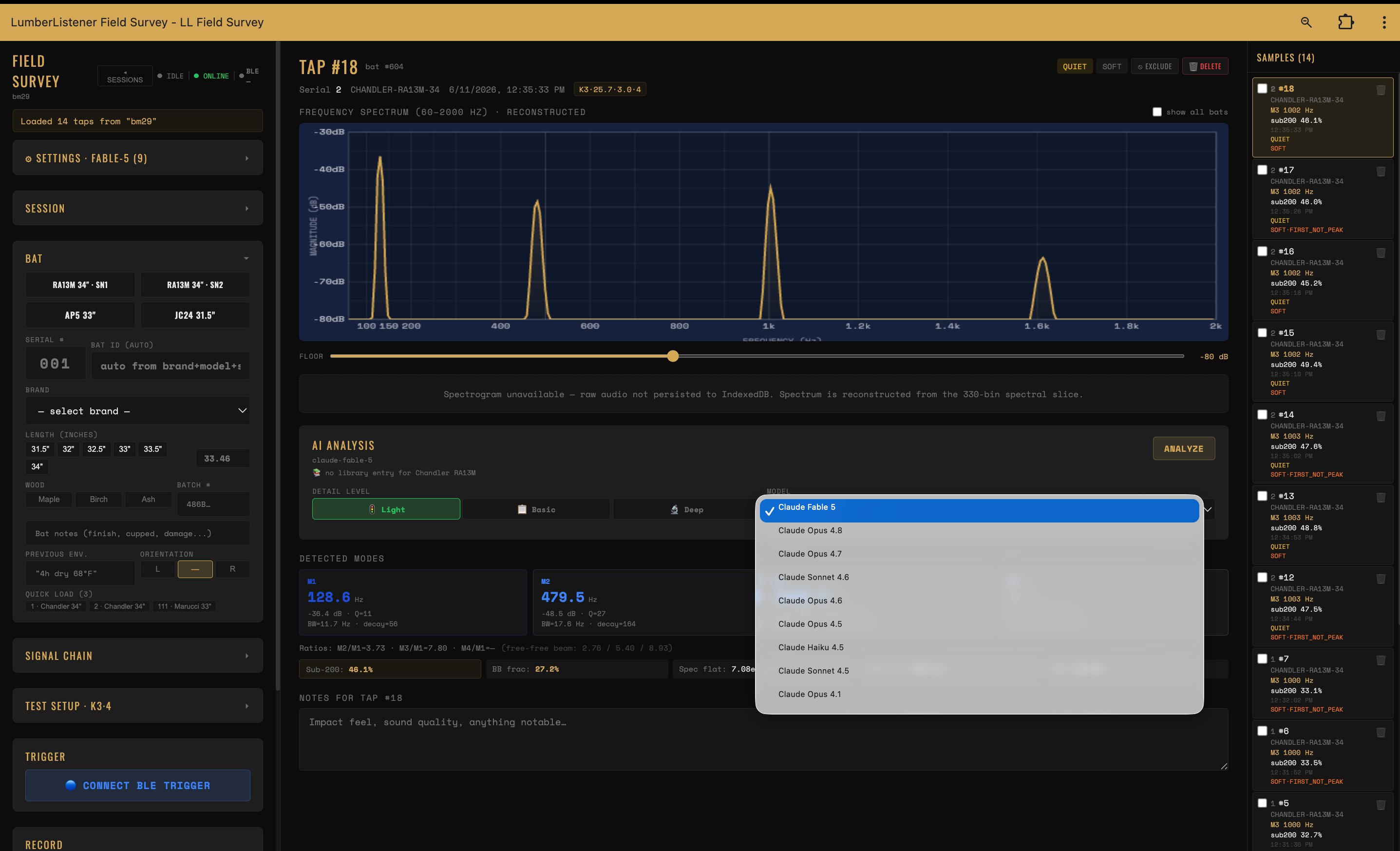
M1 first bending mode 130–175 Hz strain-prone
M2 second bending mode 450–650 Hz hand-friendly
M3 third bending mode 1000–1180 Hz hand-friendly
M4 fourth mode · less prominent 1500–2000 Hz hand-friendly
+ § 3 · Method how the measurements were made

Reach out to David for inquiries about method.

§ 4 · Cohort gradebook

Each bat graded on a curve relative to the other nine. Four metrics: Wh (ISO 5349 hand-arm), Wp (ISO 8041 perceived), (bone-resonance, 200–700 Hz), sub-200 share (tissue-dosage proxy). Averaged into the overall grade.